WHAT THE LANDSCAPING INDUSTRY DOESN'T WANT YOU TO KNOW

Scare tactics. Health risks. Pollution. Noise. Harm to children. Neighborhoods treated like industrial zones


Each of these is examined below ↓

An entire industry has normalized harmful behavior that would never be accepted elsewhere.

THE LANDSCAPING INDUSTRY IS BROKEN

An entire industry has  normalized harmful behavior that would never be accepted elsewhere.

What the industry doesn’t want you to see:

  • They are still using outdated, 1980s-era machinery in 2026—despite electric blowers that perform as well or better, without the noise, pollution, and harm.
  • Communities absorb the impact.
  • Workers absorb the risk.

This equipment isn’t used with public health in mind—it’s used for brute force.
Profit is tied to excess, not quality.

And it continues unchecked.

Local governments tolerate it.
Communities pay.
Workers pay.
The environment pays.

Ask the real questions:
Why is this still allowed?
Why are communities expected to absorb the harm?
Why aren’t existing laws enforced?

No industry should get a free pass to pollute neighborhoods and endanger workers.
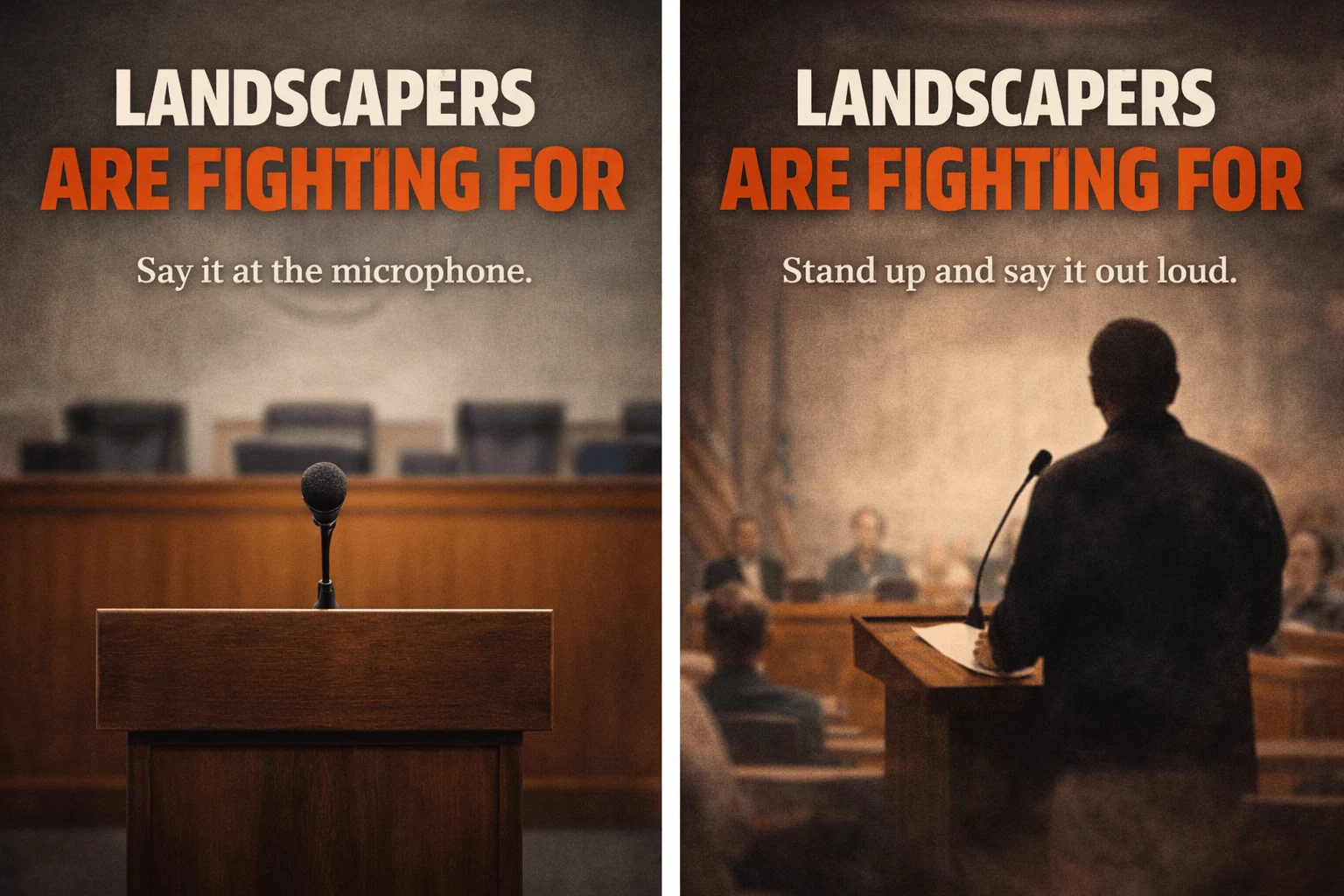
Landscapers who fight gas leaf blower restrictions should stand up and admit the truth

WHAT INDUSTRY IS REALLY CHAMPIONING IN OPPOSING RESTRICTIONS

Landscapers who fight gas leaf blower restrictions should stand up and admit the truth:

The harms industry is fighting for:

We are fighting for excessive, community-wide noise — and routine violations of local noise ordinances
 
We are fighting for daily exposure to toxic exhaust — including known carcinogens
 
We are fighting for increased long-term cancer risk, especially for workers


We are fighting for permanent hearing damage — by defending equipment that exceeds safe noise levels
We are fighting for higher cardiovascular stress — by polluting the air where people live and work
We are fighting for sacrificing worker health — insisting on loud, polluting equipment despite safer alternatives
We are fighting for exposing children and seniors to avoidable harm
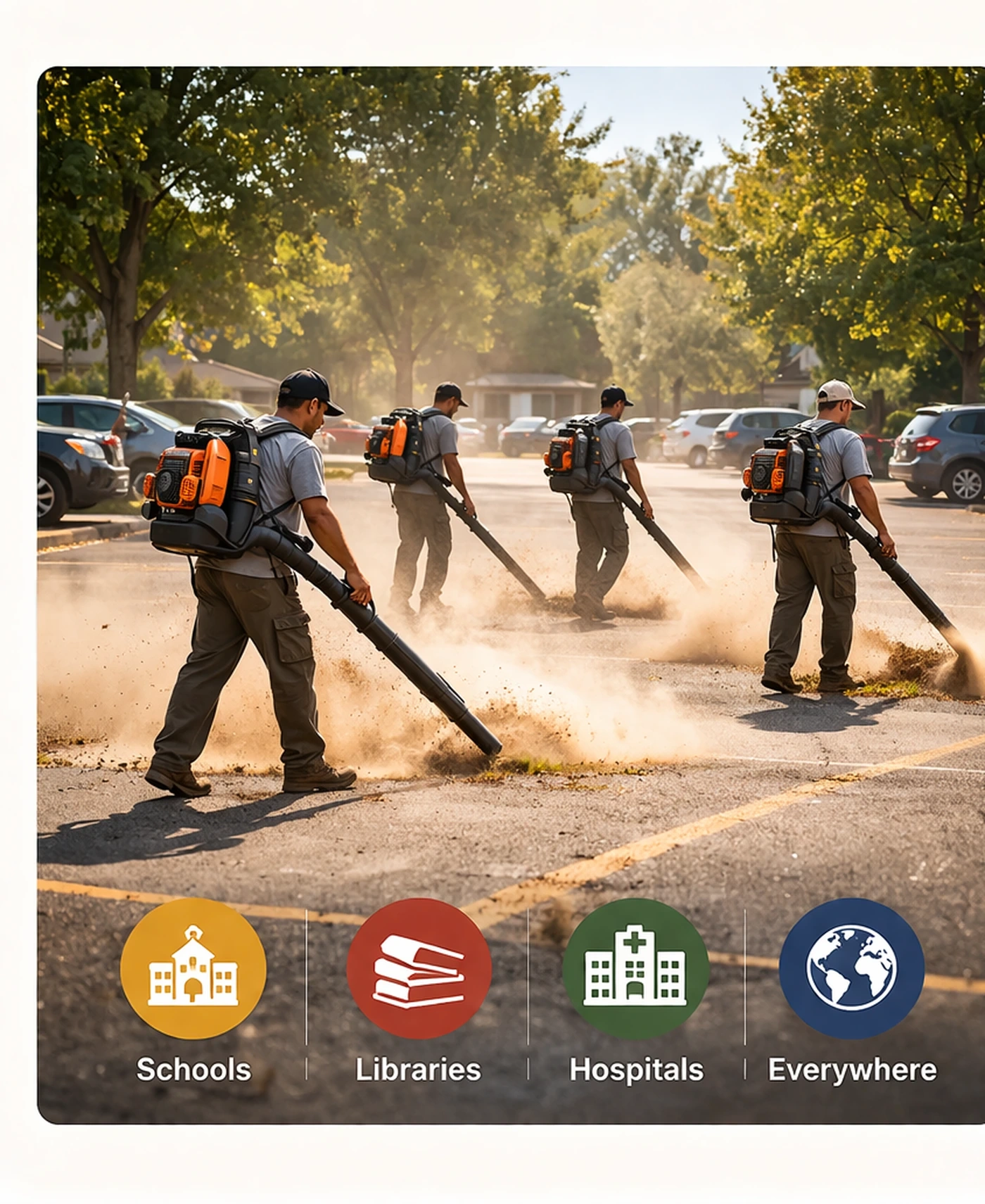
We are fighting for operating this equipment at hospitals, medical offices, libraries, and schools
We are fighting for degraded neighborhood peace and quality of life
We are fighting for continued dependence on cheap, dirty gas engines
We are fighting for lower operating costs — paid for by workers, residents, and communities
We are fighting to avoid cleaner, quieter alternatives that already exist
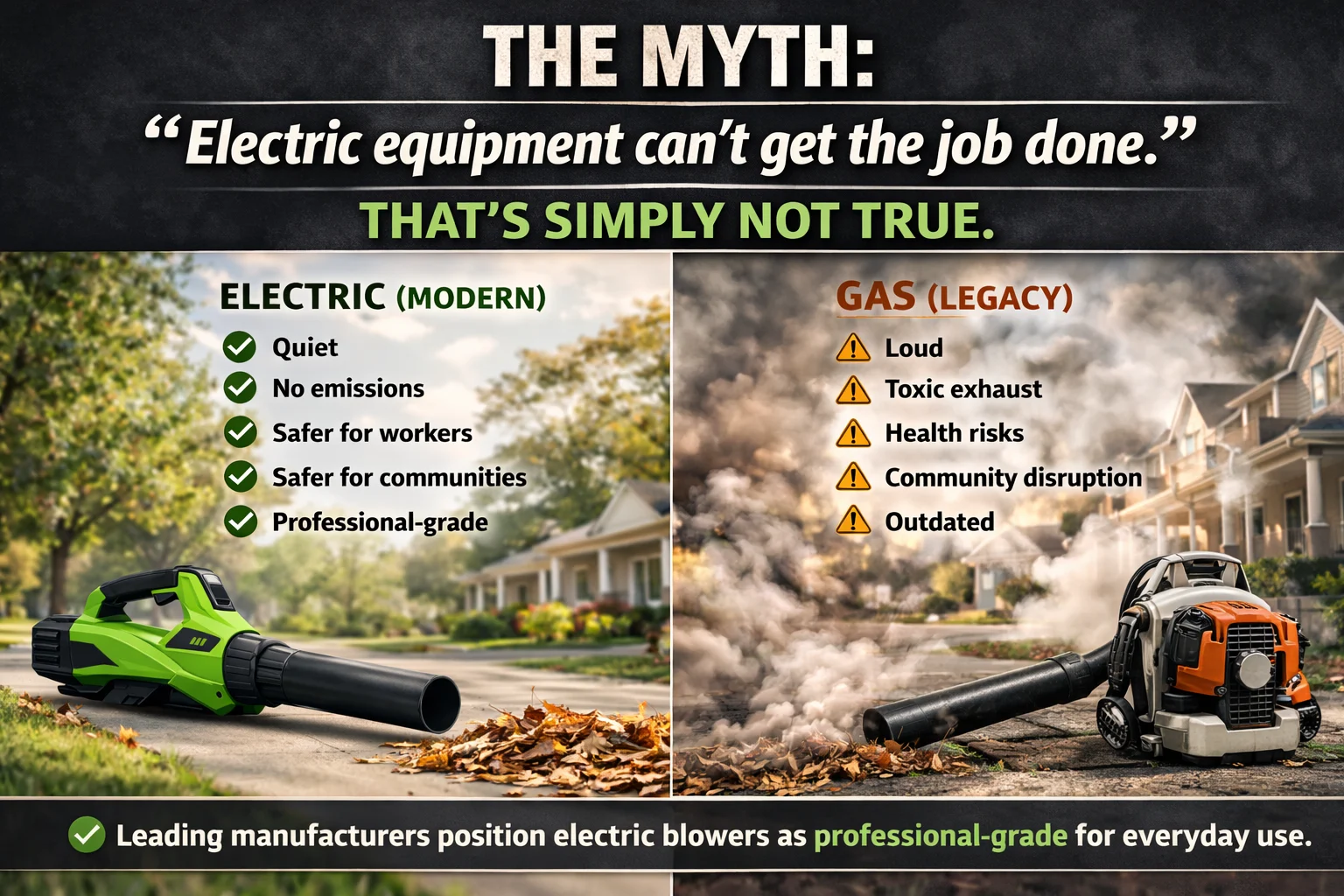
For years, the industry has pushed the idea that electric equipment “can’t get the job done.” That’s simply not true.

THE BIG MYTH - ELECTRIC CAN'T GET THE JOB DONE

For years, the industry has pushed the idea that electric equipment “can’t get the job done.” That’s simply not true.

Why this claims doesn’t hold up:

Modern electric blowers match—or exceed—the performance of gas equipment without all of the harmful impacts.

Leading manufacturers like STIHL now position electric blowers as professional-grade for everyday use.

So why does the myth persist?

Because the narrative benefits the status quo.

Gas equipment is louder, more polluting, and more harmful—but it’s also what the industry is built around. Changing that means new training, new habits, and new expectations. And because the industry refuses to change we all suffer as an unchecked industry thumbs their nose at the communities they do business in.

So instead of adapting, the message becomes:

“Electric isn’t powerful enough.”

Gas-powered leaf blowers have devolved into a revenue generating tool

THE BUSINESS OF BLOWING NOTHING

Gas-powered leaf blowers have devolved into a revenue generating tool

How noise turned into profit at your expense:

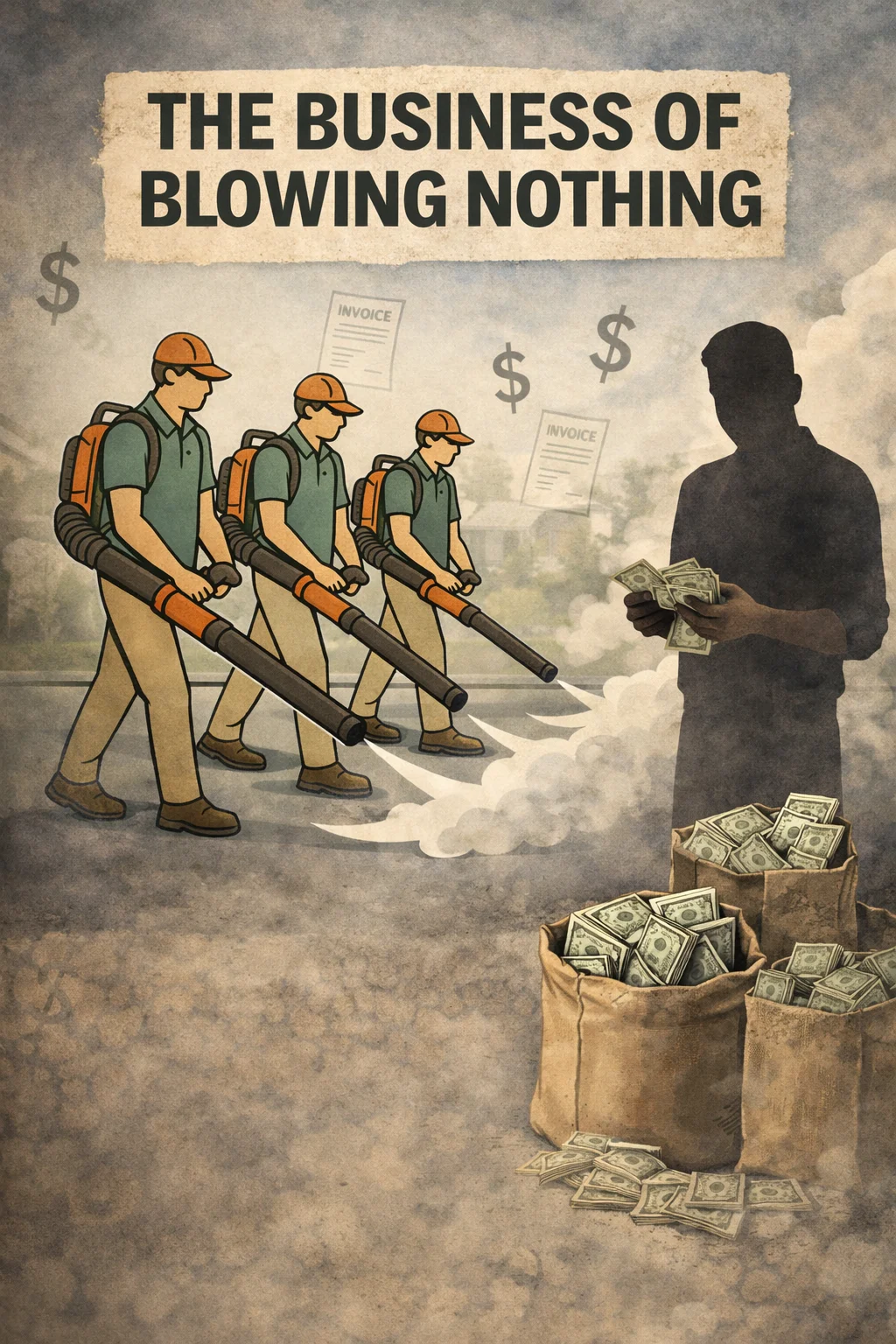
Somehow, gas-powered leaf blowers have evolved from a landscaping tool into a full-time revenue machine. Crews run them senselessly for hours — on clean driveways, empty parking lots, bare lawns, — because the louder they sound, the busier they look.

Let’s be honest: they’re not moving leaves. They’re moving money — from your peace and quiet straight into the owners’ pockets.

Meanwhile, the rest of us get the side effects:
🌫️ Clouds of exhaust and fine particulates
🔊 100+ decibels of nonstop noise
💸 Wasted fuel, wasted time, wasted sanity

This isn’t landscaping — it’s theater. A performance of pointlessness at the expense of everyone’s health, air, and peace of mind.

Maybe it’s time to stop rewarding noise for profit and start demanding peace, quiet, and real care for the places we live.

Claims that switching to battery-powered landscaping will dramatically increase costs are widely used to scare residents and policymakers—but industry data tells a different story.

THE PRICE HIKE SCARE TACTIC

Claims that switching to battery-powered landscaping will dramatically increase costs are widely used to scare residents and policymakers—but industry data tells a different story.

The truth behind the “price hike” claim:

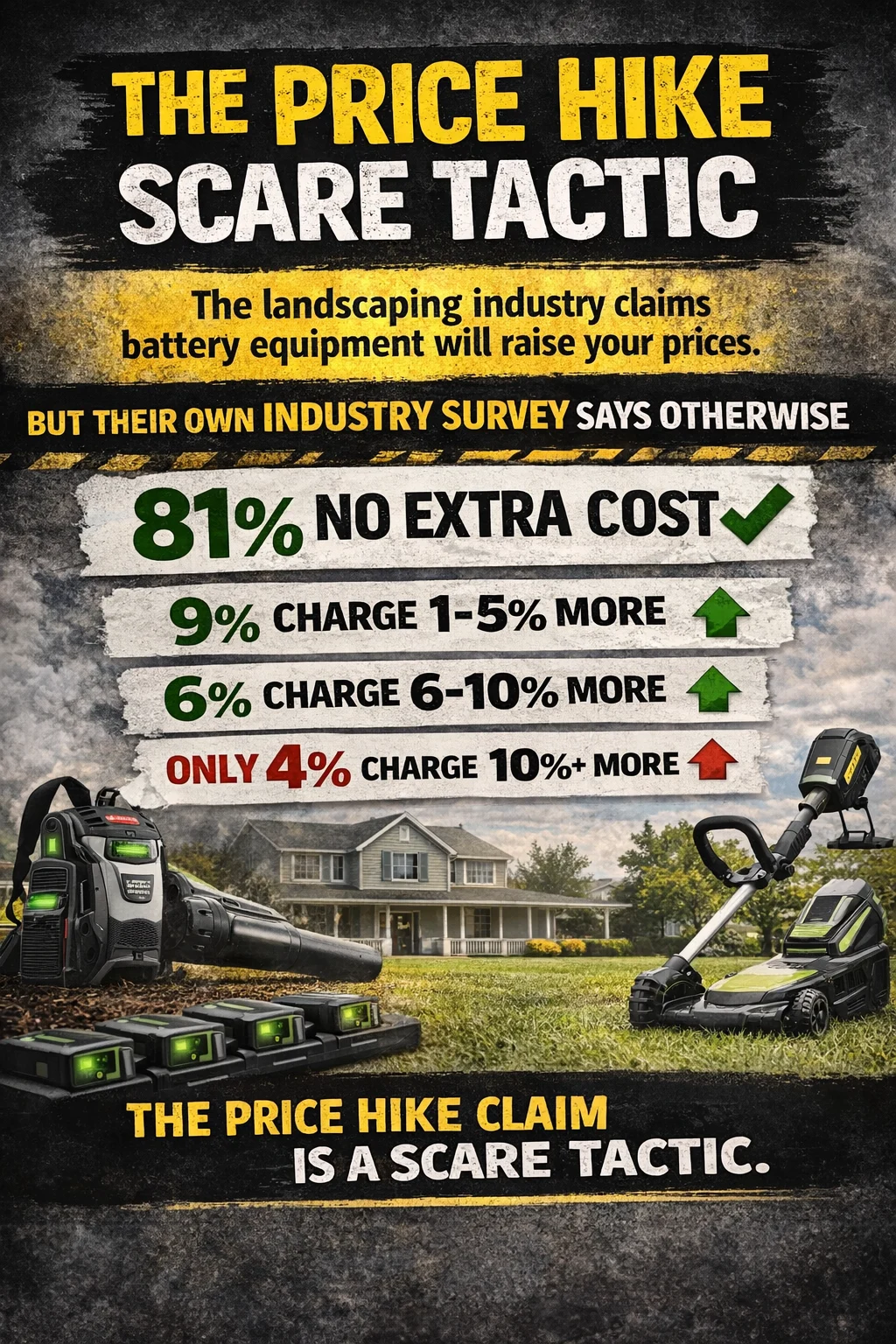
One of the most common arguments against reducing gas-powered equipment is that landscaping costs will “skyrocket.” But a survey from the industry’s own trade publication shows that claim is not supported by real-world data.

The survey asked contractors: “What premium are you charging to use battery equipment?”

81% reported no additional cost  
9% charge only 1–5% more  
6% charge 6–10% more  
• Only 4% charge more than 10%

In other words, most companies are not raising prices at all—and those that do are typically making only modest adjustments.

The data is clear: widespread price increases are not happening.

Children are being exposed and nothing is being done to stop it

WE'RE FAILING TO PROTECT CHILDREN

Children are being exposed and nothing is being done to stop it

How are children are being harmed:

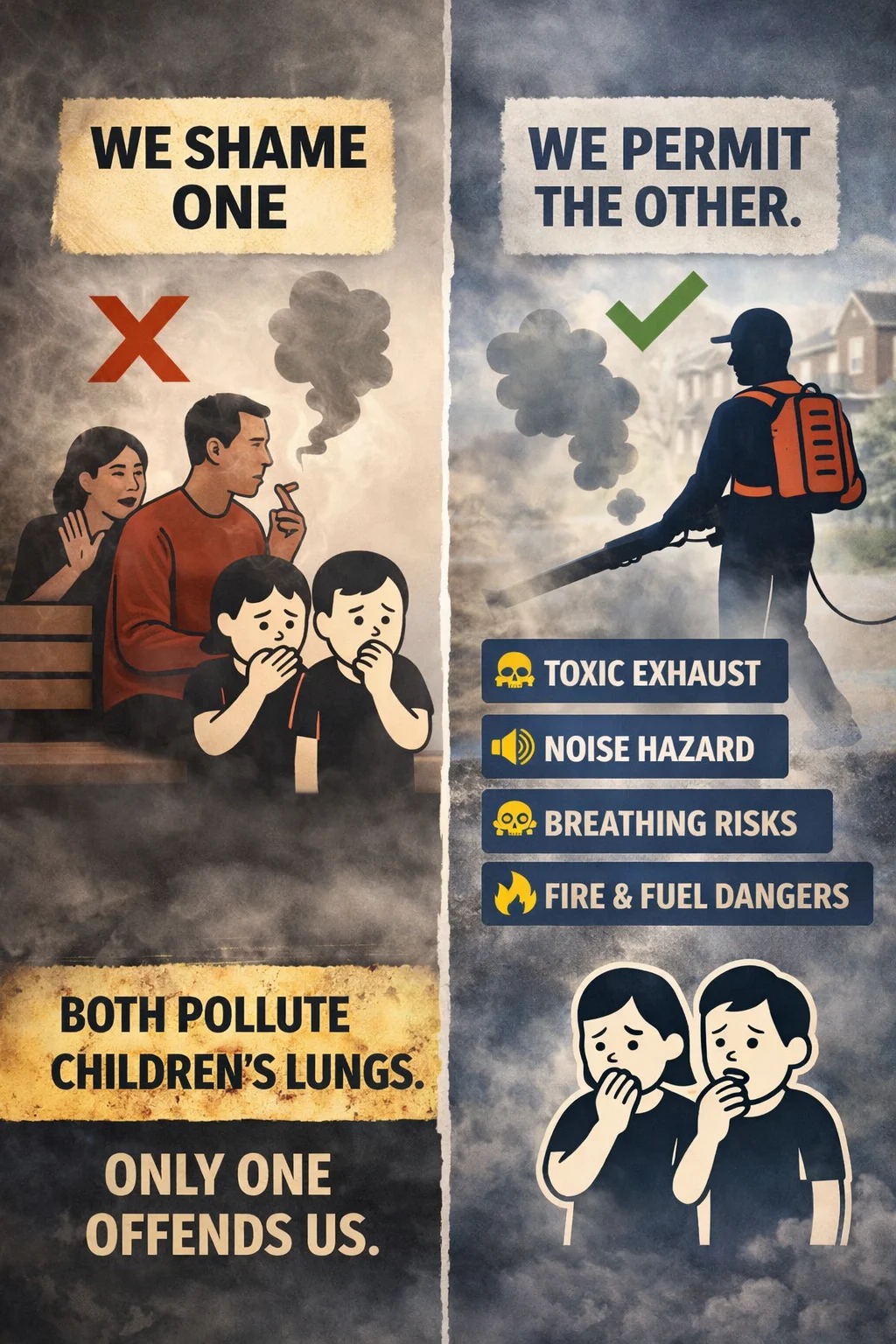
If someone lit a cigarette next to a child in a park or outside a library, we would step in. No hesitation.

Children are especially vulnerable to air pollution because their lungs are still developing and they breathe faster than adults.

Gas-powered leaf blowers release a concentrated mix of fine particulate matter, toxic gases, and known carcinogens—often at close range and exactly where children live, play, and learn

But every day, children are exposed to gas-powered leaf blowers in those same spaces—playgrounds, schools, libraries.

The exposure is real. The damage is real. The industry doesn’t care, they are getting paid. And we allow it.

This is absolutely unacceptable.


↑ Back to top

When the safety manual reads like a medical warning label… maybe it’s time to rethink gas blowers.

GAS LEAF BLOWER SAFETY MANUALS READ LIKE MEDICAL WARNING LABELS

When the safety manual reads like a medical warning label… maybe it’s time to rethink gas blowers.

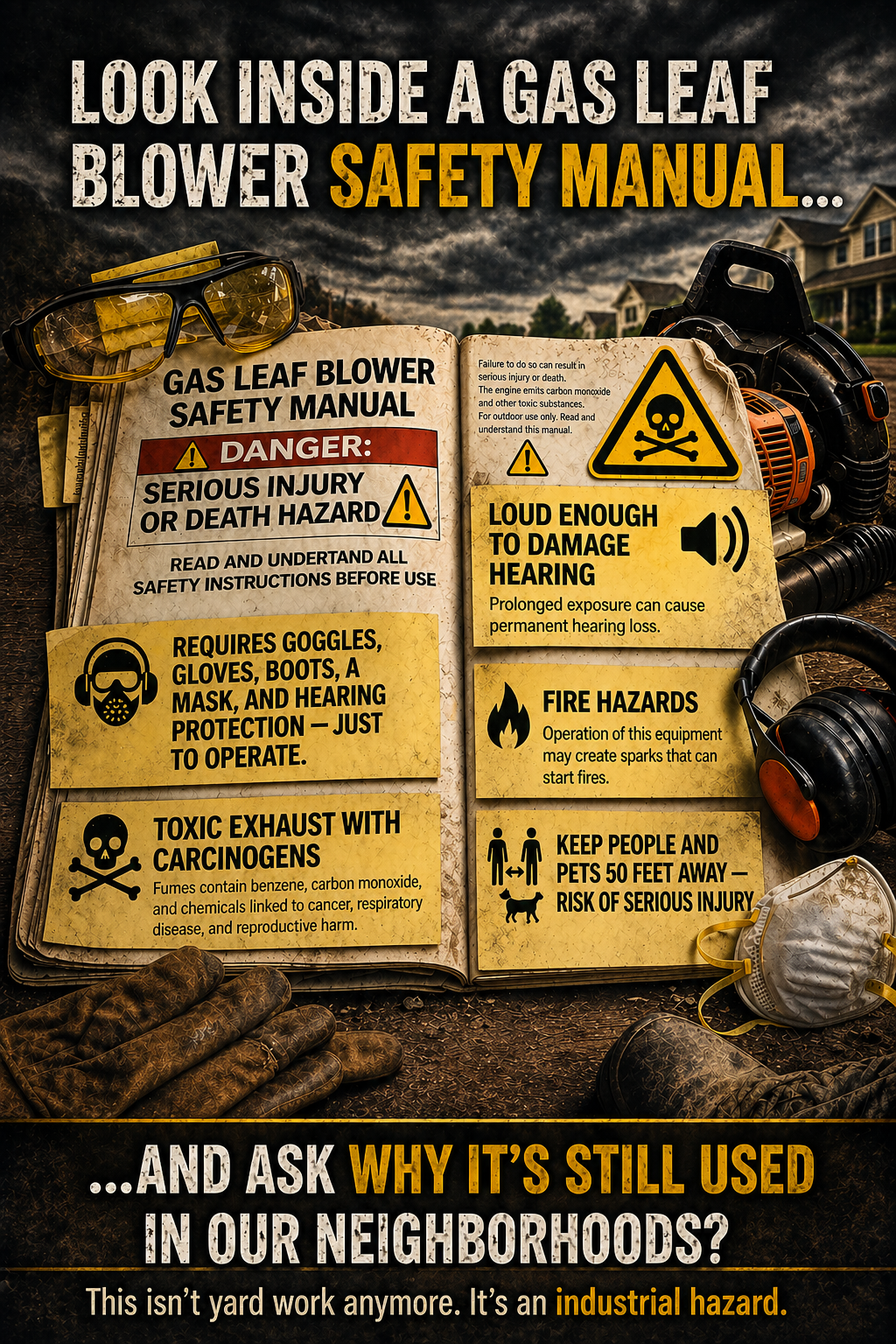
If you’ve never read a gas leaf blower safety manual, brace yourself — it reads like something that should never be used around people. Maybe it’s time to rethink gas blowers.

What the safety warnings actually say:

☣️ Toxic exhaust with carcinogens
The manual warns that fumes contain benzene, carbon monoxide, and chemicals linked to respiratory illness, cancer, birth defects, and reproductive harm.

🔊 Noise levels high enough to permanently damage hearing
The manufacturer openly states that hearing protection is required.

🔥 Fire, fuel vapor, and explosion hazards
Just refueling the machine carries risks of burns, ignition, vapor flash, and pressure buildup.

Requires goggles, gloves, boots, a mask, and hearing protection — just to operate
This isn’t yard work anymore. It’s industrial hazard management.

Meanwhile… these machines are used all day, almost year-round, often by workers with NONE of that protection.If a device requires this many warnings, this much gear, and poses this many dangers, why on earth are we still using it in every neighborhood like it’s no big deal?

The manufacturers themselves admit these machines are dangerous.
Maybe it’s time we believe them — and choose cleaner, quieter, safer alternatives. 💡🌱


↑ Back to top

Pollution isn’t an accident. It’s a business model.

THE BUSINESS OF POLLUTION

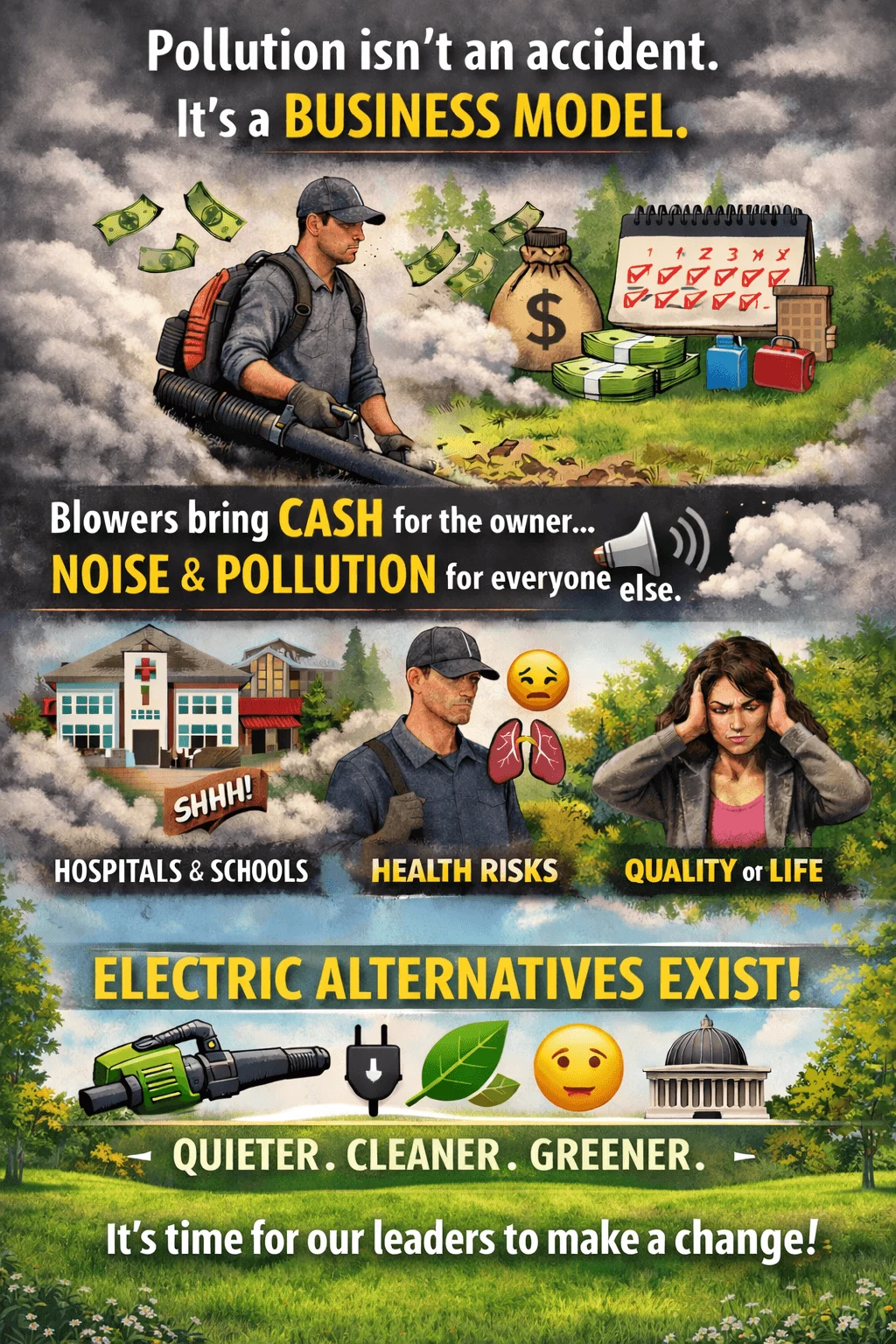
Pollution isn’t an accident. It’s a business model.

Who profits and who pays the price:

In today’s landscaping industry, the gas-powered leaf blower is a revenue engine. Every hour it runs generates money for the owner. ⛽💵

That incentive drives bad behavior. The longer it runs, the more money it generates. The more properties it covers, the more revenue it produces, so it runs all day, on weekends, on holidays, and nearly year-round — because no one with authority stops it.

It’s not cleanup — it’s landscaping theater, and bad theater at that. 🎭🍃

And every time they run, the noise and exhaust spill beyond the property line and into someone else’s air. Even hospitals, schools, and libraries — places meant for care, learning, and quiet — are treated as acceptable exposure zones. 🏥🏫📚🌬️

The owner pockets the cash while the neighborhood — and the worker operating the machine — absorb the noise, exhaust, and health risks. 👷‍♂️⚠️🌪️

The impact is real — reduced quality of life, environmental damage, and documented health effects. 📉🌍

It’s time to end profit-driven pollution and demand better.

↑ Back to top

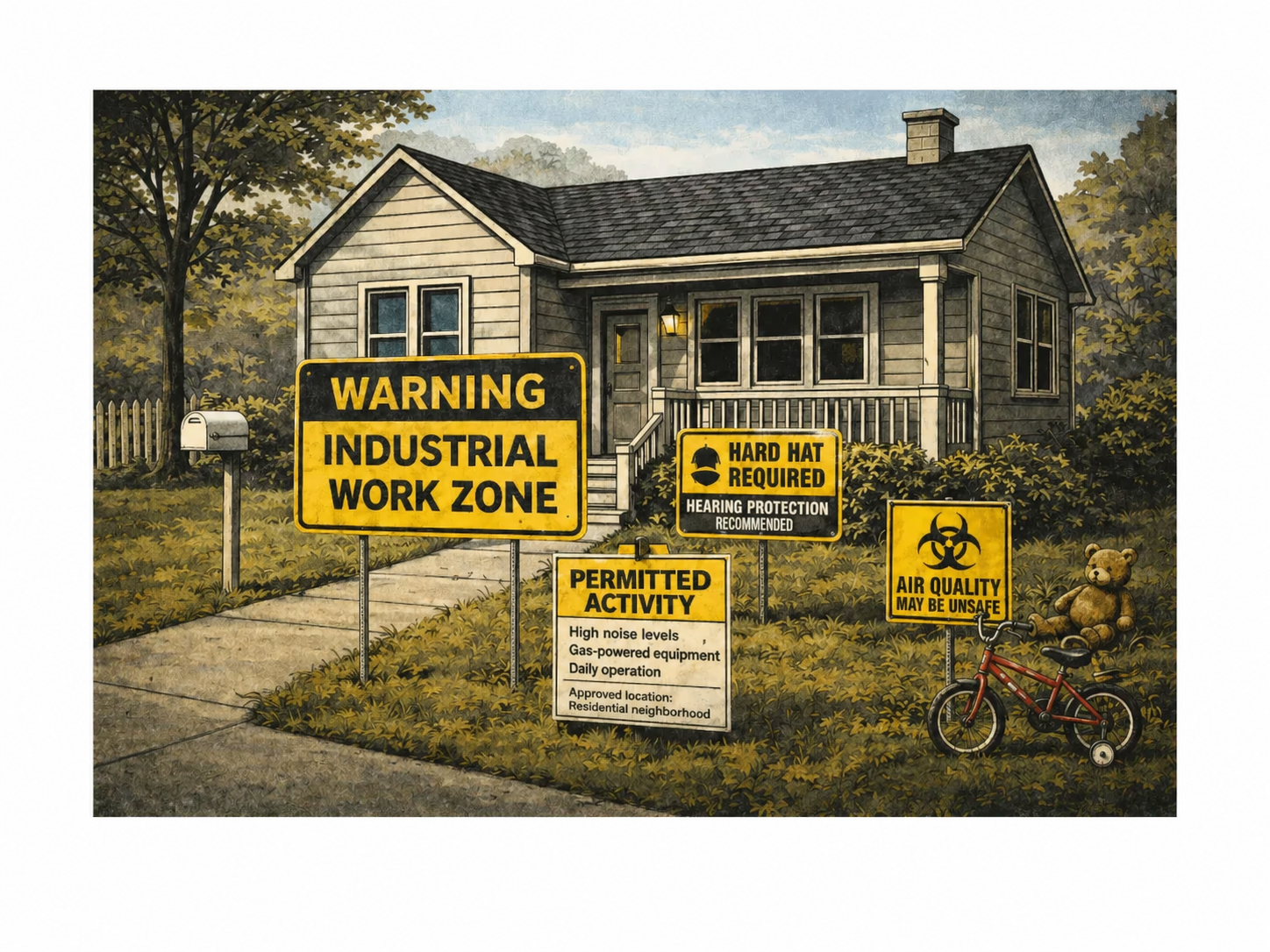
Gas-powered leaf blowers are turning our neighborhoods into industrial work zones.

NEIGHBORHOODS TURNED INTO INDUSTRIAL WORK ZONES

🏭Gas-powered leaf blowers are turning our neighborhoods into industrial work zones.

What residents are forced to live with:

🍃💨 Constant machinery noise, exhaust fumes, and disruption—every day, weekends and holidays included, almost year-round. This isn’t occasional yard care. It’s routine industrial activity imposed on where people live.
☠️ These machines don’t just make noise. They blast dangerous particulate matter and unburned fuel into the air people breathe. 

⚠️ Even in true industrial zones, equipment this loud, this polluting, and this indiscriminate would require permits, face safety rules, emissions limits, time restrictions, and enforcement. Yet in residential neighborhoods, it operates feet from homes, children, and open windows with no regulation at all. Even at hospitals, schools and libraries!

This is obscene that any municipality allows this to happen unchecked!


↑ Back to top